


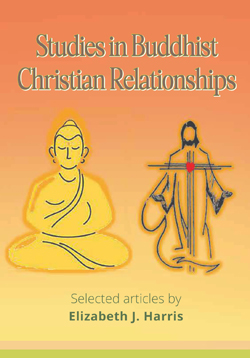
A scholarly study ennobled by a love for both Christianity and Buddhism
View(s):Writing a preface for this book, Fr. Aloysius Pieris, SJ, describes Elizabeth Harris, the author of this book, as ‘someone who has lived much of her life in solidarity with Sri Lanka’. This sums up a key factor behind Elizabeth’s inter-religious understanding, involvement and commitment, the theme of this collection.
Elizabeth is an academic, scholar in Buddhism, historian, writer, and promoter of understanding among religions, particularly between Buddhism and Christianity. Her visit to Sri Lanka in 1986 as a recipient of a World Council of Churches’ scholarship was to study Buddhism. She joined the Postgraduate Institute of Pali and Buddhist Studies (University of Kelaniya), and later became part of the Tulana Research Centre for Encounter and Dialogue, Gonawala, Kelaniya, receiving guidance from Fr. Aloysius Peiris, its founder director, known in the world as an advocate of Asian Liberation Theology, and perhaps, not that much known, one of the leading Buddhist scholars in the country and promoter of inter-religious understanding.
 After her initial exposure to Buddhist studies, Elizabeth continued in the same postgraduate institute as a doctoral researcher studying, under the guidance of Professor Y. Karunadasa and (the late) Dr Ananda W.P. Guruge, the encounter between the British and Buddhists in the nineteenth century, a topic suggested to her by Fr. Aloy according to his preface to this book.
On a personal note, I remember Elizabeth defending her thesis, in 1993, at a meeting in which, being the acting director of the Postgraduate Institute due to a brief absence of Professor Karunadasa, the director, I represented the institute. (Elizabeth’s work was later published in Routledge Critical Studies in Buddhism series, under the title, ‘Theravada Buddhism and the British Encounter’ (2006).
Looking back from 2025, Elizabeth’s involvement in the broader field of Buddhist Christian Dialogue, which includes, among other things, studies in the relationships between the two religions in Sri Lanka, has spanned almost four decades, a good part of her active academic life. What you find in this book is the cream of her scholarship in Buddhism, Christianity, and the British Colonial history related to the two religions. The collection contains altogether 14 essays covering three key areas, Buddhist-Christian relations in Sri Lanka under British colonial rule (part I), Buddhist-Christian relations after 1948 in Sri Lanka (part II), and General Buddhist-Christian studies (part III).
Under the first theme the author begins by discussing the physical and ideological encounter between the Buddhist monks and the Christian missionaries, and deals with the challenges of perceiving and making sense of each other, or, in sum, the ‘clash of cosmologies’ and pangs of being in close proximity. The other chapters cover evangelical missionary interpretations of Buddhism, two Western Indologists who were also the ‘theorists’ behind the 19th century missionary activism, Daniel John Gogerly, and Robert Spence Hardy, and Buddhist meditation and the British colonial gaze.
The penultimate chapter in the section is interesting in its perceptions of Buddhist meditation of some British writers, -not all British writers of this period were ‘the ideological marionettes of imperialism or the Christian missionary project’ (p.99)- and how those perceptions paved the way for the subsequent Buddhist modernism, have been discussed, particularly taking into consideration debates for and against Edward Said’s ‘Orientalism’.
The last of the five chapters included in this part, religion under colonial politics, outlines the efforts of Buddhists, though with limited success, to reclaim and recover their ideal past; it serves as an apt concluding discussion on the issues covered.
Part II discusses matters related to the two religions in the post-independence era of the country, such as Christian rapprochement with Buddhism, double belonging (simultaneous adherence to two religions), scriptural reasoning and symbiosis (‘interaction between religions’), confrontation over conversions, and the possible impact of dialogue on one’s understanding of the ultimate reality. All these chapters, though some sounding technical like ‘double belonging’, in fact, are historically located and contextualized with reference to many contemporary practitioners such as Aloysius Peiris, Michael Rodrigo and several others. I do not go into details of these valuable discussions for the sake of space.
The last chapter in this section, in particular, is very interesting in that the author discusses three practitioners of dialogue with Buddhism, Lynn de Silva, Aloy Pieris, and the author herself, with reference to their own encounters and experiences with Buddhism, not merely as a philosophy but more so as a practice, and draws a positive conclusion that both religions ultimately refer to a Transcendent reality which is beyond conceptualization. My mind goes to my University of Hawai’i days in 1991 when I wrote my doctoral dissertation on the problem of religious ineffability and drew a conclusion opposite to that of Elizabeth – nirvana is neither transcendental in the popular sense of the term nor ineffable. I would, however, save the debate for another occasion!
Part III of the collection, ‘General Buddhist-Christian Studies,’ covers some four interesting themes, women in Buddhist-Christian dialogue; the ‘dark night of the soul’ of St. John of the Cross and the Buddhist jhanas and arupa states; use of theology of religions and human geography to understand the spatial dimension of religion and conflict; and, the last, avatara, bodhisattva, or prophet: meeting Jesus through the eyes of the other faiths. Although these essays have been described as general Buddhist- Christian studies, the context of all of them is the dialogue between the two religions. The first starts with discussing two women orientalists, Constance Gordon Cumming, supporter of an evangelical Anglican missionary society and engaged in dialogue with Buddhists, and Bella Sidney Woolf, sister of Leonard Woolf, colonial administrator and well known writer who lived in Sri Lanka, who was in dialogue with an emerging order of Buddhist nuns in the country, and moves on to others like Julia Ching, Bonnie Bowman Thurston, Theja Gunawardhana, Professor Lily de Silva, Cynthia Mendis, Langanee Mendis, Sallie King, and Rita Gross.
The chapter on John of the Cross and Jhanas and arupa states combines Elizabeth’s theological knowledge with Buddhist textual and doctrinal expertise. The next chapter on the spatial dimension of religious conflicts brings the theology of religions and human geography together, without which, the author claims, a comprehensive study on the issue is not possible, and discusses Sri Lanka and Israel/Palestine as case studies. The last of the collection on avataras, Bodhisattvas and prophets is religious, inter-religious, philosophical and creative.
In addition to providing a mine of information in Buddhist Christian relationships in particular and inter-religious understanding in general, in this collection I see that the author has achieved a great degree of objectivity, a commodity not easy to come by, particularly in dealing with a subject matter so close-to-heart like religion. Luckily for Elizabeth, she loves both Christianity and Buddhism!
Finally, the passage from religion to inter-religion, when it is guided by love and understanding, is a thing of beauty to be cherished. The author, Elizabeth Harris exemplifies this beauty in her writings as well as in herself! I recommend this collection to all those who are keen on inter-religious understanding and dialogue, historical, textual, theological and philosophical studies and above all, to all those who care about beautiful and ennobling human relations with religion as a valid category in life!
(The reviewer is Emeritus Professor of Buddhist Studies, Department of Buddhist Studies, University of Colombo)
| BOOK FACTS | |
|
Searching for an ideal partner? Find your soul mate on Hitad.lk, Sri Lanka's favourite marriage proposals page. With Hitad.lk matrimonial advertisements you have access to thousands of ads from potential suitors who are looking for someone just like you.