

Columns
- Calls grow for Premier Amarasuriya to take responsibility and step down, but she remains mum
- As education reform process falls into jeopardy, Govt. says it suspects sabotage and lodges complaint with CID
- Budget victory in CMC and tourist arrivals offer some relief to the government
- Positive shifts in UNP-SJB unity efforts; supporters urge early direct talks between Wickremesinghe and Premadasa
By our Political Desk
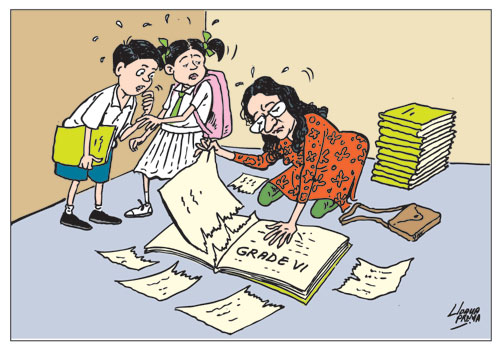
Prime Minister Harini Amarasuirya, who is also the Minister of Education, Higher Education and Vocational Education, was to kick off the first phase of the NPP government’s much-hyped educational reforms with a bang later this month, but instead, the whole process is now under public scrutiny and snowballing into a major controversy after the publication in the Grade Six English Language module textbook of a web address which directs students to a gay chat website. Some 350,000 copies of the new textbook had been printed and distributed by the Educational Publication Department, yet no one noticed the inclusion of the address of the adult website until a social activist, who had availed herself of a copy of the book, tried to log in to the web address printed in the book, only to find it directed her to a ‘hook up’ site for gay men.
The government response once the mess-up became public was predictable. Education Ministry Secretary Nalaka Kaluwewe rushed to lodge a complaint with the Criminal Investigation Department (CID) alleging ‘sabotage’, National Institute of Education (NIE) Director General Professor Manjula Vithanapathirana was asked to step down, and an internal inquiry got underway. However, both the minister in charge of the subject and the ministry secretary, with whom lies the final responsibility, have chosen to shield themselves by shifting the blame to others.
According to Prof. Vithanapathirana, the curricula and learning materials under the proposed new module for Grades 1 and 6 have been developed by the NIE through a collaborative dialogue with educationalists, interdisciplinary experts, teachers and various stakeholders. In her message on the opening page of the new textbook, the now sidelined DG also acknowledges the contribution of the Prime Minister, the Secretary to the Ministry and other officials who had worked with “exceptional dedication” in ensuring the quality of the curricula and related materials.
A copy of the Grade Six English Language First Term Modules seen by us shows that the problematic pages are printed in Module Two of the text under the heading ‘Finding Friends’. The module is to encourage the students to have e-buddies or electronic buddies (the modern-day equivalent of pen pals). The book states that an e-buddy is a person with whom someone communicates through email and other electronic platforms. The book gives three e-buddy profiles of children ranging from the age of 9 to 12 from England, India and Japan and directs them to the problematic website.
The fallout of the grade six textbook fiasco has hit the Prime Minister the hardest, with calls from some quarters for her to resign as Education Minister. Among them are trade unionists in the education sector as well as political opponents of the government. Former Minister Wimal Weerawansa has been among those calling on Prime Minister Amarasuriya to resign from her post as Education Minister, alleging that directing students as young as 10-11 to external websites, which have not been vetted by the education authorities, would expose schoolchildren to inappropriate websites.
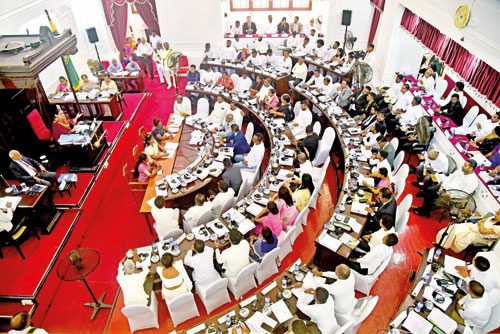
Mayor Balthazar addressing the CMC members after the budget victory on Wednesday. Pic by Akila Jayawardena
The controversy rages at a time when many countries are aiming to restrict digital platforms for children, with Australia banning children under 16 from social media effective from last December, while other countries are considering similar age-based measures amid rising concerns over social media’s effects on children’s health and safety.
Ceylon Teachers’ Union (CTU) General Secretary Joseph Stalin was among those who criticised the ministry’s decision. “There’s no point in the Education Ministry complaining about this to the CID. What the ministry should be doing is to hold an internal inquiry to get to the bottom of what happened,” he insisted. Complaining to the CID is an attempt by ministry officials to wash their hands of the issue, he charged. He added that the Education Ministry Secretary, as the senior-most education official, also cannot escape blame for the fiasco.
The CTU General Secretary observed that the names of those responsible for the module in question are included in the module itself. These include senior officials of the National Institute of Education (NIE), some of whom have no real capacity to serve in these positions but have been appointed solely because they are active supporters of the NPP, he charged.
So far Premier Amarasuriya has not commented on the matter. Deputy Education Minister Madura Seneviratne says the government takes the matter “very seriously” and alleges that there is an organised attempt to undermine the education system in the country. “We suspect that this web address was introduced deliberately to tarnish the image of the Prime Minister and the Government as a whole, which is why we lodged a complaint with the CID,” he said.
Much of the criticism directed at the government has been about the haste to implement education reforms without following the due process to educate parents and teachers and provide the basic facilities for all students to cope with such changes. The education reform process has lacked any comprehensive public discourse, while the only discussions have been limited to those with trade unions affiliated to the ruling Janatha Vimukti Peramuna (JVP)-led NPP and workshops for teachers, while other trade unions and parents have been left out of the process.
“Under these reforms, they were also talking about introducing 14 modules for further learning but are now saying they can only introduce six modules initially. From where are they going to find teachers if they don’t have them to teach these modules? Even the school timetables have so far been changed four times. It is clear that they can’t even implement things they had been talking about. What they should do now is to hold proper discussions with educationists and initiate a broad review of these reforms before implementing them,” Mr. Stalin said.
This is one reason that the government has had to backtrack from an earlier decision to extend school time by half an hour. School hours were originally due to be extended by 30 minutes for students from Grade 5 upwards when the new education reforms took effect in January, with the time period of each period being extended to 50 minutes. The move ran into strong opposition from teacher and principal unions. They warned of trade union action if the Education Ministry implemented the school hour extension. The Education Ministry, however, announced on Thursday that a decision has been taken not to extend school hours during the 2026 academic year, due to begin on January 5. The ministry cited the disruptions caused by the recent disaster situation and damage caused to school and transport systems in several provinces for backtracking on the earlier decision. Accordingly, school hours for Grades 5 to 13 will remain unchanged from 7:30 a.m. to 1:30 p.m. until the education and transport systems return to normal. Grades 6 to 13 will have 7 periods in a school day, with each period lasting 45 minutes.
While the Education Ministry claimed the disaster situation had prompted its decision to temporarily postpone the extension of school hours, Mr Stalin insisted that the ministry had been forced into the decision owing to the threat of trade union action by unions representing teachers and principals. “We have been saying from the beginning that the move to extend school hours past 1.30pm was a pointless exercise. We warned the ministry that we would be compelled to initiate trade union action if it went ahead.”
He said unions continue to maintain opposition to any move to extend school hours and called for a pause on implementing the education reforms until a thorough review, warning that going ahead with the problem-plagued reforms now will only serve to further lower the public’s trust in them.
Amidst this growing public outrage, there is also concern regarding the other new modules to be introduced through the education reforms from this year. The subject of sex education has been a touchy area, with members of the Buddhist and Catholic clergy alleging that what is on the cards would do more harm than good. However, Prime Minister Amarasuriya has said that the government will introduce an age-appropriate sex education programme for children, with the objective of reducing sexual abuse.
Colombo’s Archbishop Malcolm Cardinal Ranjith, a leading critic of the proposed age-appropriate sex education, has said the so-called reforms risk eroding the country’s cultural and religious foundations and undermine parental authority.
He alleged that the Sri Lankan school curricula were developed based on the International Technical Guidance on Sexuality Education (the Guidance) commissioned by the United Nations Educational, Scientific and Cultural Organization (UNESCO). The Guidance was developed to assist education, health and other relevant authorities in the development and implementation of school-based and out-of-school comprehensive sexuality education programmes and materials. It is relevant for government education ministers and their professional staff, including curriculum developers, school principals and teachers.
With the term for Grade Six students set to begin on January 21, the plan is to remove the relevant pages which refer to the adult website and issue the book with guidelines to teachers on how to proceed with teaching the contents of the missing pages. It’s a slipshod response to a major blunder for which no one in government seems to want to take the responsibility.
NPP tastes CMC victory in second vote
While the education sector was in turmoil, there was some good news for the government this week where the Colombo Municipal Council (CMC) was concerned. As was noted in this column last week, the defeat of Budget 2026 of the NPP-majority CMC when it was first presented on December 22 was not just a humiliation for the ruling party in general but also an embarrassment for President Anura Kumara Dissanayake. This is because he had become personally involved in ensuring that his party secured control of the biggest prize on offer during last year’s local council elections. President Dissanayake canvassed for support among smaller political parties and independent groups whose backing was crucial for the NPP to secure control of the 117-member CMC.
The President’s efforts were vital for the NPP, which has 48 seats, to win control of the CMC in June through the election of Vraie Cally Balthazar as Colombo Mayor by 61 votes to 54. That election was held through a controversial secret ballot, but after the NPP took control of the council, its administration received open support from 11 members of smaller political parties and independent groups, as well as a UNP member now functioning as an independent, giving them 60 seats in the council. This majority, however, was always shaky given the different entities the NPP relied on. The fickle nature of this support was made evident as the NPP administration’s budget was defeated by 60 votes to 57 when it was first presented on December 22, with three councillors from independent groups that had been backing Mayor Balthazar changing sides to vote against her budget.
With the budget due to be presented for a second time on December 31, the NPP’s negotiators went into overdrive to ensure they had enough numbers to pass the budget on the second attempt. By law, a second defeat of the budget would not have meant the NPP would lose control of the CMC or that the mayor and deputy mayor would have had to step down from their positions. Local council administrations can still continue for two years even if budgets are defeated, with heads of those institutions losing their positions only if the budget is defeated during their third year. Nevertheless, for the NPP, which had gone all-out to secure control of the CMC, getting Colombo’s budget passed was a matter of prestige, especially considering that it had suffered a string of demoralising budget defeats in close to a dozen ‘hung’ local councils where it had also relied on others to secure control.
Not surprisingly, there was plenty of intrigue surrounding Wednesday’s second vote, with the budget being passed by 58 votes to 56. The three councillors from two independent groups that had switched sides to vote against the budget during the first vote held on December 22 again stuck to their guns and voted against it on the second occasion as well. The defections and absences that ultimately sealed the deal for the NPP came from the more established political parties. The Sri Lanka Muslim Congress (SLMC) has four seats in the CMC. All four councillors had voted against the budget on December 22. On Wednesday, however, SLMC councillor Zohara Buhary defied her party and other opposition colleagues to vote in support of the budget. Video of the budget vote shared on social media showed the surprise and shock on the faces of Buhary’s opposition colleagues when she called out her ‘Yes’ vote. In marked contrast, NPP councillors were overjoyed and broke out into cheers and applause.
Ms Buhary was suspended from her party soon after the vote. In a letter to Ms Buhary informing her of her party suspension, SLMC Secretary Nizam Kariapper pointed out that she had been present at a group meeting where SLMC Leader Rauff Hakeem had personally conveyed the decision to oppose the CMC budget. As such, the SLMC Secretary has noted Ms Buhary had acted in direct contravention of express instruction of the party leadership and that her conduct “constitutes a grave and serious violation of party discipline.”
Ms Bhuary, who describes herself as a social activist, was appointed by the SLMC as a councillor and gave an explanation for her decision to vote for the CMC budget the second time. She told journalists she chose to support the NPP “unconditionally”. She claimed she had been fair to both sides, pointing out that she had voted against the budget a week earlier. Her decision to vote ‘No’ the first time, along with her opposition colleagues, was to prove a point that the opposition had the majority in the CMC, Ms Buhary said. After this was done, though, a good number of opposition councillors were of the view that the opposition too should support passing the budget on the second occasion, given there was nothing wrong with the budget itself and that it was a good budget for the people of Colombo, she claimed. She alleged her other colleagues in the opposition had been prevented from voting for the budget by the leadership of their respective parties. “I chose to give priority to the people,” the dissident SLMC member said. She insisted she had not been influenced by anyone to vote for the budget and that the decision was hers and hers alone.
Colombo Mayor Vraie Balthazar and several other CMC councillors visited Ms Buhary at her home on Friday to thank her for her support and inquire into her welfare.
Meanwhile, several other councilors from a number of opposition parties were absent during Wednesday’s vote. One councillor left before the vote claiming his wife had suddenly fallen ill and been admitted to hospital. Two other councillors were absent and were uncontactable as their mobile phones had been switched off. The Samagi Jana Balawegaya (SJB) announced on Wednesday that it had suspended the party membership of CMC councilor Shane Daniel Ram, who had been absent during the vote.
Taking to social media after the passage of the budget, Mayor Balthazar stated that the victory “allows us to move forward with the work we promised the people of Colombo. We will now focus on delivering better services, responsible spending, and practical improvements that matter to daily life in our city. The task ahead is clear, and we are ready to get to work.”
While the NPP might be breathing a sigh of relief after the passage of the CMC’s budget, the contrasting results during two votes held just a week apart shows that going forward, any sort of vote involving the entire CMC could be decisive, said United Peace Alliance (UPA) CMC Councillor Kaleelur Rahman. “The numbers are really tight and while the administration will still continue, things might get rather chaotic. We might also see further instances of councilors changing sides or being absent during votes.”
Mr Rahman, whose party has two seats in the CMC, supports the NPP administration. He criticised decisions taken by opposition parties to take disciplinary action against councillors over their conduct during Wednesday’s vote. “It is understandable if disciplinary action is taken against councillors who vote against their party’s wishes during the election of a mayor. But it is different when it comes to the budget. It is one thing if the budget is bad, but we could gather from speeches made by opposition councillors during the debate that even they were of the view that there is nothing wrong with this budget. As such, for the opposition parties, this was a case of them playing politics with the budget and putting their own interests ahead of the people of Colombo.”
SJB General Secretary Ranjith Maddumabandara, though, claimed the NPP passed through the CMC budget through “intimidation tactics,” adding it was clear that a “conspiracy” had been hatched to pass the budget. He said the party will take appropriate action after examining what led to the outcome.
UNP-SJB unity efforts
Amid the drama surrounding the CMC’s budget vote, the SJB and UNP are continuing their efforts to reunite, though there is still no sign of any official agreement. Opposition and SJB Leader Sajith Premadasa, who has personally taken over negotiations on behalf of the SJB, met with a UNP delegation that included Akila Viraj Kariyawasam, Navin Dissanayake and Ruwan Wijewardene on Tuesday. “Had productive and constructive discussions on challenges faced by our motherland and the importance of formulating innovative policy prescriptions that would fulfil the national objectives in an effective and efficient manner,” Premadasa wrote on his Facebook page, along with a photograph of the meeting, though he made no mention of the discussion being aimed at reunification. UNP Leader Ranil Wickremesinghe also called Premadasa on Thursday to wish him a happy new year.
A senior SJB leader, though, said any reunification talks will ultimately prove futile without direct meetings between the two leaders. “That is the only way to reach a lasting agreement. All these meetings with delegations will only drag this process on. The two leaders must talk face-to-face,” he said.
Tourist arrivals offer relief to Govt
The government, meanwhile, has some further cause for relief after tourism arrivals and earnings were not impacted as heavily as feared following the devastation caused by Cyclone Ditwah. Sri Lanka attracted over 2.36 million tourists in 2025, with total tourism revenue coming to USD 3.2 billion, Foreign Affairs, Foreign Employment and Tourism Minister Vijitha Herath told the Sunday Times. He put down the success in mitigating the negative headlines from the disaster to the government’s proactiveness in quickly moving to allay the fears of tourists feeling uneasy about visiting Sri Lanka after the disaster. He said the Foreign Ministry instructed its diplomats based overseas to brief travel agents in their respective countries and stress that Sri Lanka is safe for tourists. They were also asked to actively carry out tourism promotions and also to speak to the media. Regulations that normally prevented diplomats from speaking to the media or travel agencies without approval from the Foreign Ministry were lifted so that they could use their own initiative and reach out independently to such entities. Mr Herath claimed this helped greatly to minimise the negative impact on tourism from the disaster.
The minister also noted that various Memorandums of Understanding (MoUs) that the Foreign Employment Bureau had signed with other countries had also helped increase foreign remittances from Sri Lankan workers to USD 7.2 billion last year. Accordingly, the combined revenue from tourism and foreign remittances came to about USD 10.4 billion, he said.
| Probe on CMC corruption On December 30, the day before the CMC’s budget for 2026 was due to be presented for the second time, President Anura Kumara Dissanayake issued an extraordinary gazette notification appointing a Commission of Inquiry (CoI) to probe into alleged acts of fraud and corruption in the CMC from 2010 to 2025. The three-member CoI will be headed by Piyasena Ranasinghe (former High Court Judge) and also includes E.R.M.S.H. Ekanayake (Sri Lanka Accountants’ Service – Grade I) and D.S. Wikramasinghe (former Senior Superintendent of Police). In the gazette, the President has noted that substantial losses and damage have been incurred to state assets and revenue as a consequence of alleged acts of fraud and corruption that have taken place in the CMC, and that the Council had been “unable to achieve its intended development objectives.” | |
Buying or selling electronics has never been easier with the help of Hitad.lk! We, at Hitad.lk, hear your needs and endeavour to provide you with the perfect listings of electronics; because we have listings for nearly anything! Search for your favourite electronic items for sale on Hitad.lk today!
Gay website for Grade-Sixers: A textbook case of government under fire
View(s):