

Sunday Times 2
Why our reservoirs cannot prevent floods during extreme rainfall
View(s):By Eng. Thushara Dissanayake
Our recent experience with the massive disaster brought by Cyclone Ditwah clearly indicated how vulnerable the country is to an extreme rainfall event.
The impacts fell mainly into two categories: flooding across the major river basins and numerous landslides in the hill country. Many major river basins, including the Mahaweli, Kelani, Kalu, Maha, Attanagalu, and Deduduru, overflowed, affecting thousands of households and many cities and suburbs.
Much criticism was directed at state agencies responsible for reservoir management, such as the opening of spill gates, during the event. While floods are not new to the country, the question is whether we can cope with a similar or even more severe disaster in the future, especially given the finite reservoir storage available. This article discusses why Sri Lanka’s major reservoirs cannot prevent floods during severe rainfall.
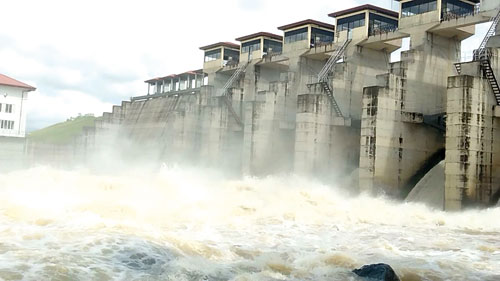
Lanka’s reservoirs: Primarily for irrigation and hydropower generation--not for flood control
Reservoirs are not designed primarily for flood control
Sri Lanka’s multipurpose reservoirs, mainly built by the Accelerated Mahaweli Development Programme, and other irrigation reservoirs have not been designed as flood control reservoirs, though occasionally they perform that task on a minor scale.
For their primary functions, irrigation and hydropower generation, the storage levels are maintained as much as possible by capturing rainwater to guarantee the supply of water adequately for the intended purposes. Thus, these reservoirs will accommodate sudden floodwater only if they are below the full supply levels at the time of flood.
On the contrary, if the authorities receive accurate forecasts about the time and quantity of expected rainfall, there is a chance of lowering these reservoirs by releasing water before a flood situation. However, they will reach their full capacity quickly, forcing spill releases to protect the dam if the rainfall event is severe. Hence, our reservoirs cannot fully prevent river floods in extreme events, unlike dedicated flood control dams available in countries such as Japan.
Extreme rainfall volumes far exceed reservoir storage
Extreme rainfall events produce catchment runoffs that far exceed reservoir storage itself. For instance, the recent Ditwah cyclone generated runoff flows in Deduru Oya. It was equivalent to several times the storage of the Deduru Oya reservoir. Hence, reservoirs can capture only a fraction of floodwater even if they are fully empty at the onset of the event. In other words, reducing the water levels of reservoirs before a severe flood event has no significant advantage.
Multiple tributaries create runoff that reservoirs cannot regulate
Owing to the topography, many major rivers of Sri Lanka consist of several tributaries with larger catchments. During an extreme event where the whole basin gets equally extreme rainfalls, these tributaries generate runoff in parallel. Many major reservoirs are located upstream of the connecting points of certain tributaries with the main river in certain river basins. As a result, runoff of certain tributaries flows bypassing the reservoir. For instance, all the major reservoirs in the Mahaweli system, namely Kothmale, Victoria, Randenigala, and Moragahakanda, are situated in the upstream catchment. Hence, runoff of other tributaries of the Mahaweli, such as the Uma Oya, Badulu Oya, and Loggal Oya, bypasses these reservoirs. Consequently, low-lying areas in the downstream, Mahiyanganaya and Polonnaruwa, have a higher chance of getting flooded by extreme runoffs of these tributaries if severe rainfall is received by their catchments.
Not all the river basins
have reservoirs
Many major river basins, such as Attanagalu, Kalu, Gin, and Nilwala, are not equipped with major reservoirs. The Kelani River has reservoirs like Castlereagh and Maussakelle, only at the most upstream, designed for hydropower rather than flood control. Therefore, heavy runoff in the Kelani always leads to flooding in Colombo and the suburbs, and only the flood bunds can control the flood risk to several areas. A similar situation can be observed in the Kalu, Gin, Nilwala, and Attanagalu basins as well.
The need to take urgent
action on dam safety
Extreme rainfall events can lead to dam overtopping unless spill gates are operated in time. A dam failure would cause a massive disaster due to the sudden release of a large volume of water at a higher velocity. As a result, a destructive flood wave will be generated, sweeping away buildings, bridges, and other properties adjacent to the river, with heavy land erosion. Hence, it goes without saying that the damage would be manyfold compared with a flood event. Further, the disruption of the agricultural and power generation activities that depended upon the reservoir will add to the total economic loss in the long run.
Hence, reservoir operators have to take action with utmost care to protect the dam. They must monitor catchment rainfall and consequent inflow to the reservoir. If the inflow is too high, they must release water irrespective of the fact that the downstream area has a flood risk. The only thing they can do is to give a timely warning to downstream residents to either evacuate or follow suit. Most of the time, these are not individual decisions but instructions given in reservoir operation guidelines by the respective authority. The reservoir operators have to follow these instructions to ensure the safety of the dam.
Climate change is causing
high-intensity rainfalls
So far, Sri Lanka has dealt with monsoonal rains with random occurrences of low-pressure regions in the Bay of Bengal, resulting in heavy downfalls and, in some cases, cyclones. However, with climate change, rainfall events of 200-400 mm within a day are likely. It is high time that we analyse possible rainfall intensities in the future with the help of climate change models to strengthen disaster preparedness and mitigation activities. Therefore, operating our major reservoirs based on such data will have to be reconsidered to utilise their potential in flood mitigation, if possible.
Conclusion
Sri Lanka’s major reservoirs have been designed primarily for irrigation and hydropower generation. Consequently, their capacity to mitigate floods during extreme rainfalls is inherently limited. Flood mitigation must therefore adopt different approaches, including the construction of dry dams and flood bunds, the development of efficient and reliable early warning systems, and public awareness and preparedness programmes. Accordingly, flood risk reduction requires an integrated, multifaceted strategy that extends beyond existing reservoir operations, incorporating both structural and non-structural measures.
(The writer is a chartered civil engineer specialising in water resources engineering.)