

News
It feels like Xmas with Heel Oya cypress trees
View(s):By Malaka Rodrigo
Every December, amid Colombo’s glittering lights and plastic decorations, a quieter reminder of nature arrives from Sri Lanka’s misty hills. Cypress trees are transported to the capital, carrying with them a fragrance that many Sri Lankans associate with Christmas.
“Most of us are from Heel Oya in Bandarawela,” says R.M. Wijesinghe, a vendor the Sunday Times met beside Havelock Road. “We arrived about a week ago. We cultivate these trees mostly on private lands and nurture them for one or two years. Luckily, our plots received the gods’ protection, so these were not impacted.
The fresh, resinous scent released by the cypress fills homes and churches, creating what many describe as the “real Christmas ”aroma”—something no plastic replica can offer.
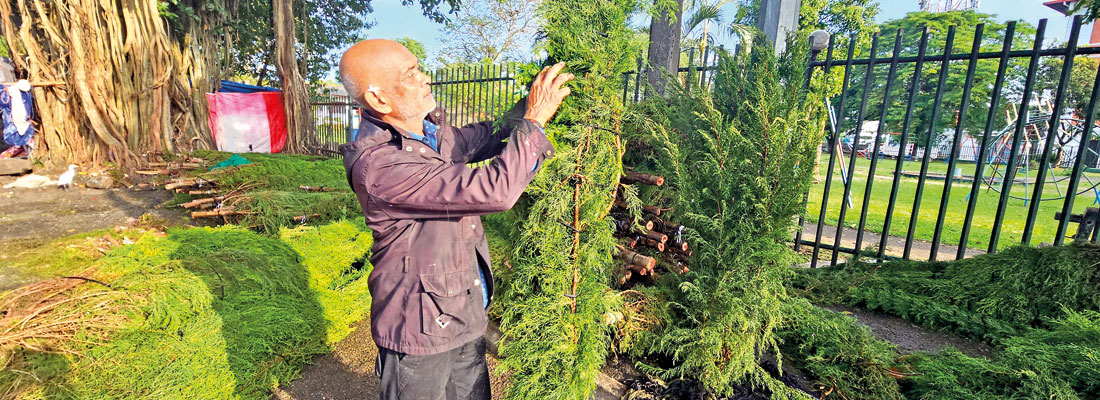
Bringing the fragrance of Christmas to the city: Cypress tree vendors from Heel Oya, Bandarawela
The trees belong to a cypress species grown in the cool, wet hill country. Their soft needles, symmetrical shape and distinctive scent have made them a seasonal favourite for generations of Sri Lankan Christians.
“When we bring a real tree into
the house, it feels like Christmas is alive,” said Sanjeewa Gomez, a Colombo resident who has avoided plastic trees for years.
Heel Oya villagers have cultivated cypress trees for Christmas for more than half a century. They plant saplings years in advance, knowing they will only be sold when they reach the right size and form.
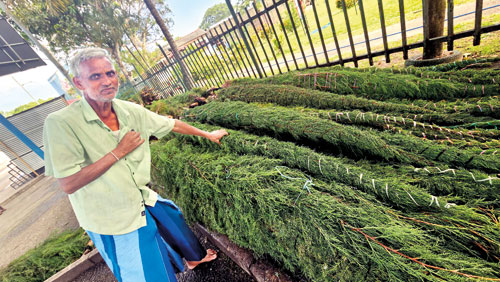
One vendor, Tikiri Banda Wijesundara, 67, said this year marked his 47th consecutive season in the capital. “I first came to Colombo as a 20-year-old,” he said. “I’m still coming because people are waiting for these trees. They want something real.”
The annual journey has become a tradition in itself—one that ties rural growers to urban families through a shared seasonal ritual rooted in nature.
Cultivating Christmas trees is a slow and demanding process. When the cypress trees are young, growers must protect them from wildlife such as deer and porcupines, which can snap branches or damage the bark, permanently deforming the trees, says Bandula Weediyarathne, another cypress tree grower.
“These trees are like children,” Mr Weediyarathne says. If they are hurt when young, they never grow properly in symmetry. Unlike plastic trees, natural trees represent years of care, exposure to weather, and vulnerability to loss — a reality that reinforces their value as living symbols rather than disposable decorations. ”
Despite their cultural and ecological appeal, vendors say demand for natural Christmas trees is declining. Imported plastic trees are cheaper, widely available and marketed as reusable.
But environmentalists point out that plastic trees contribute to long-term pollution. Once discarded, they remain in landfills and waterways for decades.
Natural cypress trees, by contrast, are biodegradable. Some are replanted in home gardens or church compounds, while others return to the soil.
“A real tree completes a natural cycle—plastic only breaks the connection,” Mr Wijesundara says. “We bring over 1,000 trees carefully cut and bundled not to disturb the leaves. But sadly we have to leave some behind, as demand is sometimes low.’’
The future of Sri Lanka’s natural Christmas trees is also tied to the stability of the hill country landscapes where they are grown. Areas such as Heel Oya lie within regions increasingly prone to landslides, intensified by heavy rainfall, land degradation and climate change.
Although recent extreme weather events, including Cyclone Ditwah, did not directly damage the cypress plots, growers remain concerned. A single landslide could destroy years of cultivation and erase a tradition that depends entirely on healthy hill ecosystems.
“These trees survive because the land survives,” one grower said. “If the hills are lost, this tradition will disappear too.”
Some Sri Lankans continue to seek out natural trees each year for their homes, churches or schools—determined to keep Christmas connected to the living world.
For them, the cypress tree is more than an ornament. It is a reminder that celebrations need not be separated from nature and that joy can still grow from the soil.
The best way to say that you found the home of your dreams is by finding it on Hitad.lk. We have listings for apartments for sale or rent in Sri Lanka, no matter what locale you're looking for! Whether you live in Colombo, Galle, Kandy, Matara, Jaffna and more - we've got them all!