

Columns
Increasing export earnings amidst global trade wars
View(s):The government, satisfied that the country has obtained a reduction in US tariffs on our exports, is expecting a further tariff reduction before August 1.
Although US tariff reductions on our exports are a benefit, they are an inadequate concession for several reasons. First, our competitors, especially in garment exports, have secured a lower tariff. Second, US tariffs are volatile and uncertain, and the basis on which President Trump imposes tariffs is impulsive and not on economic reasons. Third, our trade with BRICS countries, particularly Russia, India, China, and Iran, could be jeopardised if the US places bans or higher tariffs on countries that trade with BRICS member countries.
Negotiations
Nevertheless, the government must redouble its efforts to obtain further tariff concessions from the US while also increasing its efforts to expand trade with other countries.
Way forward
The way forward for our exports is to find other markets, diversify and increase our exports, and reduce our import needs by enhancing domestic production, especially food, through import substitutes.
Favourable markets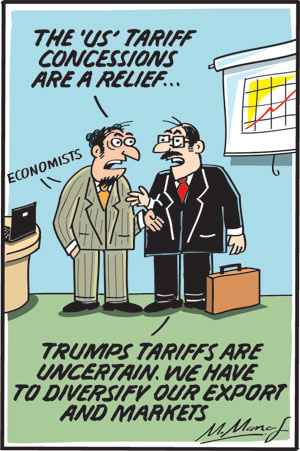
In the first instance, we must strengthen the favourable conditions we have obtained from the European Union (EU) countries and the UK. The EU is our second largest market, and the GSP Plus concession we have is of utmost importance for our exports.
Strategies
In this uncertain and inhospitable global climate for trade, we cannot rely on tariff concessions alone. We must develop new strategies to increase our exports. The priority should be to consolidate our EU’s GSP concessions.
GSP Plus
We must ensure the continuance of the GSP Plus concessions we enjoy and increase our exports to EU countries by addressing human rights concerns expeditiously.
Potential
According to EU officials, there are prospects of increasing our exports to EU countries. Repealing the Prevention of Terrorist Act (PTA) should be a priority. We cannot afford to delay it any longer. Perhaps the EU has given a deadline.
United Kingdom
The UK’s decision to bring down the tariffs on Sri Lanka’s exports to 10 percent is a significant gain. We must explore the prospects of increased exports to Canada.
East Asia
We must also explore the prospects of exporting rubber goods, ceramics, and other manufactured goods to China and Vietnam—countries that have already expressed their willingness to expand their trade with us. Similarly, we must seek markets for our manufactures in Japan and SoutheastAsian countries, such as Indonesia and Malaysia.
Australia and New Zealand, where we have a migrant population, too, are potential markets that have been neglected owing to our westward focus.
Private sector
Sri Lanka’s exports are mostly in the hands of private enterprises. Profitability would be the key driving force. The government’s role would be to facilitate trade through policies. While the negotiations with the US and other countries are significant, the costs of production of our exports must be competitive with those of other countries.
Exchange rate
An important determinant of our competitiveness is the exchange rate. It is important for the government, as well as people, to understand that the rupee should not be overvalued. In a nutshell, so to speak, the depreciation of the currency increases our competitiveness, and the appreciation of the rupee makes our exports dearer and consequently less competitive.
Unfortunately this economic truism is not understood, and the government intervenes to not let the rupee depreciate. This reduces the country’s export competitiveness.
Production costs
There are ways by which the government could assist exports. It should reduce production costs by offering a lower electricity tariff to export manufacturing industries. Import duties on raw materials for export manufacturers should also be reduced or eliminated. Para tariffs should be eliminated.
Government role
The government has an important role in assisting the private sector to find markets abroad for exports through diplomacy. Our foreign missions should be oriented to economic diplomacy and work in collaboration with the trade ministry, the Export Development Board (EDB), and exporters.
Summary and conclusion
The way forward for our exports is to find new markets, diversify and increase our exports, and reduce our import needs by enhancing domestic production and import substitution.
If the tariff wars continue, our exports could be seriously jeopardised by the high tariffs in our main markets. In this inhospitable and uncertain climate for trade, we must increase our exports to EU countries by removing the required conditions on human rights expeditiously. The UK’s gesture to reduce tariffs on Sri Lanka’s exports, as well as the prospects of increased exports to Canada, are opportunities that must be exploited.
Final word
The current trade uncertainties are a formidable challenge as well as an opportunity to strengthen our export structure.
Buying or selling electronics has never been easier with the help of Hitad.lk! We, at Hitad.lk, hear your needs and endeavour to provide you with the perfect listings of electronics; because we have listings for nearly anything! Search for your favourite electronic items for sale on Hitad.lk today!
Leave a Reply
Post Comment